Engineering note
High Temperature Axial Fan — What the Heat Actually Breaks
From the test bench and the panel — practical notes from an axial fan factory that builds, winds and tests these motors itself.
Two temperatures that are not the same number
When people search for a high temperature axial fan, the spec sheet usually starts with one number. Which number? That's the first thing to nail down, because a fan sees two temperatures and they are not the same one. Ambient temperature is the air sitting around the motor — a transformer room in July may hold 45 °C at fan height. Air-off temperature is what actually flows between the blades. Exhaust air leaving a winding stack runs far hotter than the room it came from, and a fan mounted on the hot side of a baffle drinks that air directly. The winding doesn't feel the duct — it feels its own copper loss plus whatever temperature wraps the frame. Bearings sit in the middle: heated by the shaft, the frame and the housing they press into. So the practical question for a hot application isn't 'how hot is the air' but 'which material touches which heat'. Write the number, then write the surface it acts on, in that order. Grease choice, insulation class, whether the impeller is plastic or steel — everything downstream comes out of those two answers. Skip this step and you'll buy a fan that survives its rating on paper while it cooks inside your installation.
Bearings: the lubricant quits first
The bearing is where heat shows up first, because it's the one component whose film can chemically age. Most compact AC axial fans run on sleeve bearings — sintered bushings soaked with oil, no rolling elements. Our sleeve bearing page covers the trade-offs; the short version is that sleeve life is oil life, and hot chambers burn oil down faster than anything else. A ball-bearing build trades oil for grease, and grease has published limits. Per SKF's grease selection guide, a standard mineral-oil lithium grease such as LGMT 2 covers -30 to +120 °C; their polyurea LGHP 2 raises the ceiling to +150 °C. Note what those numbers are: working ranges, not endurance targets. Inside the range, hotter operation still shrinks relube intervals hard — the top of a grease's range is where it survives, not where it thrives. The steel has a ceiling too, lower than most buyers guess. Per SKF's heat-treatment documentation, bearing rings are stabilized by class: SN up to 120 °C, S0 up to 150 °C, S1 up to 200 °C. Beyond the stabilization class, rings and rolling elements keep creeping in size and the fatigue math shifts. Past roughly 120 °C at the bearing seat you're no longer picking a catalog line — you're specifying a grease grade and a stabilization class. That's a conversation with an engineer, and it should happen before the purchase order, not after the first season of failures.
Insulation class is a budget, not a target
Insulation class confuses buyers because the letter looks like a temperature rating when it's really a spending plan. Per the Engineering ToolBox reference on the NEMA/IEC framework, Class F insulation has a maximum allowable operating temperature of 155 °C and Class H of 180 °C, with full-load temperature-rise limits of 105 K and 125 K respectively. Here's the part that matters in hot rooms: the whole scheme assumes 40 °C reference ambient. Class F hits its 155 °C total as 40 °C ambient + 105 K rise + a hot-spot allowance. Raise the ambient to 65 °C — realistic in a sealed cabinet stacked next to a drive — and the budget left for rise shrinks by 25 K all by itself. A Class F motor in hot air does not gain 25 °C of headroom; it loses it. Then the chemistry kicks in. Per the same reference, every 10 °C above the rated maximum cuts expected insulation life roughly in half. That's how a fan wound Class F ends up the cheapest thing in the panel to burn: not because the insulation failed, but because nobody derated the rise for the real ambient. A datasheet that says 'Class H' means something only when the rise limits behind it were checked against your conditions. Ask for the class and the rise basis together. One without the other is a letter, not a spec.
Plastic parts creep before metal even notices
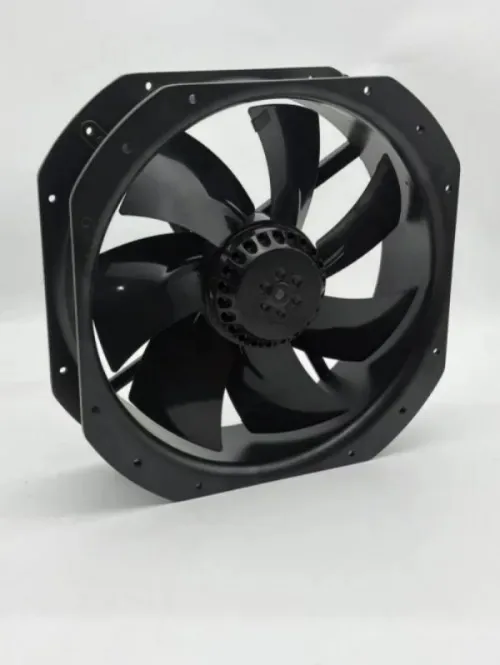
Then there's everything that isn't steel. Impellers, blade tips, wire insulation, terminal blocks and grommets are usually thermoplastic, and their ceilings fall off a cliff compared to metal. The Engineering ToolBox materials tables put Nylon 6/6 at about 75-100 °C maximum service temperature, and glass-filled nylon (35%) only slightly higher at 75-110 °C. Polypropylene drops out sooner. These aren't dramatic failure points — they're where stiffness starts sliding. A nylon blade in a 95 °C airstream doesn't melt. It creeps. Centrifugal force loads the blade root every revolution, creep bends pitch slowly, and the first loud symptom is a blade brushing the shroud at the tip clearance you didn't design. That's the plain reason hot-duty conversations at our factory end up on the metal side: the 28080 metal axial sits in our metal-guard axial family as a capacitor-run model. The same materials table keeps steel structural parts in service at several hundred degrees — nobody cools a fan that hard. In a hot-duty fan, what fails first is rarely the metal hardware — it's the same two soft targets from earlier sections: grease and insulation. Keep them cool and the rest of the bill of materials is boring.
Signals you've left catalog territory
Catalog shopping stops working when a few signals stack up. Any one of these turns a purchase into an engineering conversation. The bearing seat runs hotter than your grease's published range. The ambient eats your insulation class's rise budget. Parts in the airstream sit past about 100 °C with plastic in them. The fan runs 24/7 in a hot spot instead of cycling. The shaft is vertical in a hot chamber — which already shortens sleeve life on its own. Here's what a factory evaluation actually buys you, and what it doesn't. ZHENDA is a 110-person factory with 10 engineers on R&D, and we publish test facts instead of adjectives: finished fans go on the bench for voltage and current, RPM, airflow and static pressure, noise and vibration, plus insulation and hipot checks where required. Our CE certificates cover a named model band that includes both the 25489 and the 28080. Four of our models sit in UL component file GPWV2.E535099 — a component file for fans built into your equipment, not a finished-equipment certification, and we don't dress it up as anything else. What we won't do is print a 'withstands X °C' claim for a condition we haven't run a fan in. Send your numbers through the contact page — the answer states plainly what's already built, what needs a test, and what we won't pretend to do.
The two hot jobs that actually reach us
Two applications cover most of the hot-fan questions we get. First: transformer rooms. A forced-ventilated dry-type transformer gets its airflow from axial fans at the base, pulling room air up through the winding stack and out the top louvres. The fan eats both temperatures at once — room ambient on its motor side, hotter air on the way out — and a room that holds 45 °C on a July afternoon gives you no credit for the winter it didn't have to survive. Our transformer cooling guide covers thermostat practice; the 25489 is the big capacitor-run model in the power-equipment range that covers box-substation and dry-type transformer duty. Second job: energy-storage cabinets and containers. Our published application guide lists energy-storage cabinets, containers and charging stations among the places our AC axial fans actually go — manufacturer application scope, not a lab claim. The physics there is sun soak plus inverter heat: a sealed enclosure in direct July sun is a preheater before a single watt leaves the battery, and nighttime low-noise setpoints cut the airflow right when desert air is still 40 °C. Don't guess either number. Log one hot day at the real mounting height, with the real load, and read the peak off the recorder. One afternoon of data beats any nameplate — and if that peak crosses the ranges in this article, that's your signal to start the engineering conversation while the fan is still a line item and not a shutdown.
Sources
- SKF — Heat and surface treatment (rolling bearing stabilization classes SN/S0/S1)
- SKF Bearing Grease Selection Guide (PDF, SKF distributor knowledge base; LGMT 2 -30/+120 °C, LGHP 2 -40/+150 °C)
- Engineering ToolBox — NEMA Insulation Classes (Class F 155 °C, Class H 180 °C, 40 °C reference ambient, 10 °C life rule)
- Engineering ToolBox — Engineering Materials Properties (Nylon 6/6 max service 75-100 °C, glass-filled nylon 75-110 °C)
Read next:
Questions a brochure cannot answer?
Ask an engineer, not a chatbot — the quote form reaches our team.