Engineering note
Shaded Pole Motor Fans — the Simplest AC Fan, Explained
From the test bench and the panel — practical notes from an axial fan factory that builds, winds and tests these motors itself.
What a shaded pole motor is
Shopping for a shaded pole motor fan? Start with what is inside the housing. A shaded pole motor is the simplest AC induction motor there is: a laminated stack, one concentrated winding and one or more copper shading rings around part of the pole face. The shading ring delays the flux in that portion of the pole, which is enough to create a weak rotating field and start the rotor turning. No capacitor, no start switch, no centrifugal switch — few parts, low cost, and nothing to wear out electrically. Several of our compact axial fans (the smaller frames listed on the AC range page) are shaded-pole builds; the capacitor-run FZY series is the step up.
Where the input watts go: the shading ring, heat and efficiency
Here is where the input watts actually go, because this is the part no shaded-pole data sheet itemizes. Per the All About Circuits textbook, the shading arrangement is a shorted turn embedded in each pole, set 30° to 60° from the main winding, with roughly a third of the pole face enclosed by a bare copper strap. Electrically, that strap is a one-turn secondary on a transformer that never stops running. The alternating flux induces a voltage in it; the induced current has nowhere to go but through the copper's own resistance; I²R does the rest. Heat, in the plainest sense. And the same lag that makes the motor self-starting also squanders the field it comes from. ebm-papst rates shaded-pole motors at the bottom of its efficiency table — in the range of 20 to 40%, against 60% to 70% for permanent split capacitor machines, per the same source. Per All About Circuits, starting torque is so low that these motors are only manufactured in sizes below 50 watts. So the field is elliptical rather than round: thin torque per ampere, and a low power factor on top, because the fan pulls magnetizing current that never shows up as airflow. In a 16 W machine, a large share of what you pay the meter for never reaches the air. Judge one at the bench or in the warehouse and you'll feel it: after a day's run, the housing of a shaded pole motor fan is warm for a reason.
Why that simplicity has a ceiling
The rotating field is weak, so starting torque is low and efficiency is modest — more of the input wattage leaves as heat than on capacitor-run or PSC designs. Speed control is crude (tap or impedance control), and the motor dislikes high static pressure: stall a shaded-pole fan against a blocked grille and it draws stalled current and gets hot. That is not a defect — it is the duty envelope. Free-air or lightly filtered panel ventilation at moderate ambient is exactly what the design is for.
Shaded pole vs capacitor-run (PSC) fans
A capacitor-run (permanent split capacitor) fan adds a run capacitor and a second winding: roughly twice the efficiency band, markedly better torque under filter resistance, and better behaviour at hot spots. It costs more per unit. Our rule for buyers: unfiltered or lightly screened panel duty under continuous moderate ambient — shaded pole wins on price; filter-ventilated cabinets, welding machines and any application where the fan must still move air against real pressure — quote the capacitor-run FZY and W-series models.
Judge one on the bench: rpm, torque, current
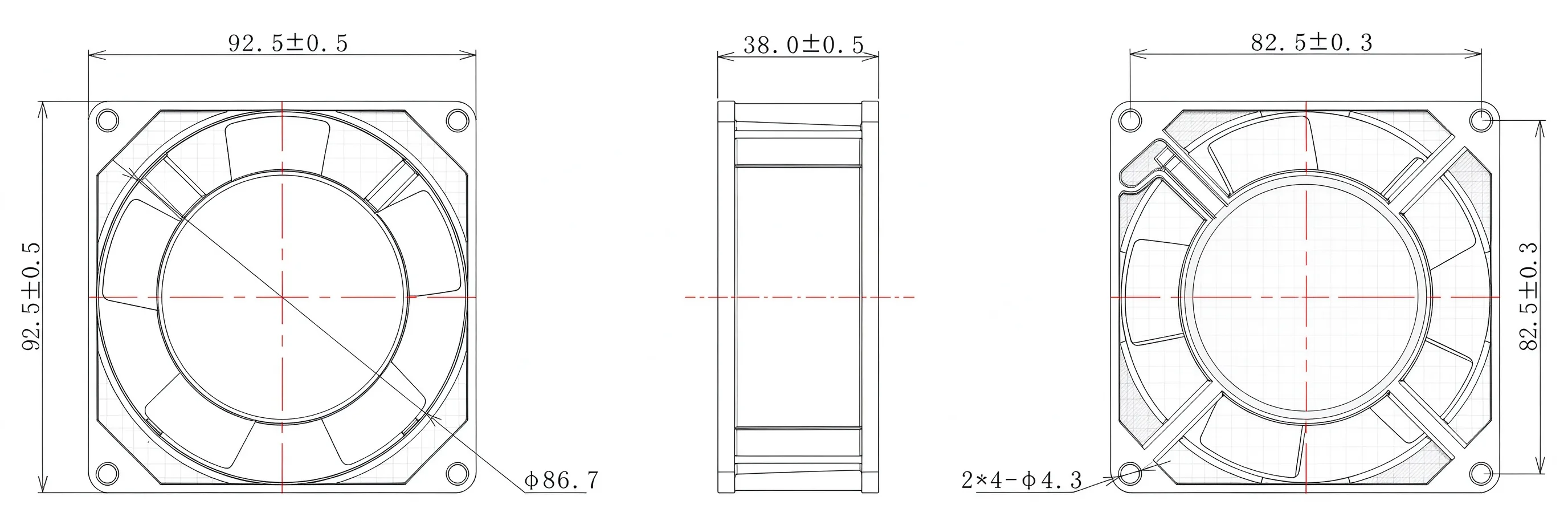
You can tell a healthy unit from a dying one with your hands and a clamp meter. No lab. Power off first, then spin the rotor by hand: it should turn freely and coast to a stop without a rasp or a flat spot. Gritching or a notchy feel points at the bearing, not the winding — the sleeve-versus-ball trade-off is covered on our bearings page. Now run it at rated voltage and read two numbers. Current first. Every honest data sheet lists rated current; the 9238 sheet, for example, states 16 W and 0.13 A at 115 V. A fan in service that pulls clearly above its sheet number while running slow and running hot is being starved mechanically — dust caked on the blades, a warped frame, a tired bearing — or the winding is failing. Slow plus high current plus hot is never one problem alone. Speed second. Compare measured rpm against the sheet. Slip is built into this motor type, but a wide gap between the paper number (2,400 rpm on the 9238) and what your tachometer says means drag you can usually find with a flashlight. Torque is the thumbs test. A shaded-pole machine has thin torque margin by design; if mild back-pressure from your palm makes it sag or stall, that margin is already gone, and a real grille will finish the job. One caution before you energize anything: at locked rotor these units draw stalled current and turn it straight into heat, so never hold one stalled to compare amps — a second or two if you must, not minutes. Don't buy a fan whose numbers you cannot check.
How to tell what you are buying
Ask the supplier three questions: does the data sheet list a capacitor (µF) — if not, it is shaded pole; what is the input power at the rated airflow — shaded-pole units draw noticeably more watts per unit of airflow; and is there a PQ curve — an honest curve exposes how fast airflow collapses with static pressure, whichever motor is inside. Every rated model page on this site publishes its curve.
The three questions, turned into a buying checklist
The three-question test is a start. Here is the version you can run against a quote sheet in ten minutes. Check one: capacitor or not. A run capacitor listed in µF means PSC; no capacitor means shaded pole. While you're at it, ask for the datasheet revision date and confirm it covers the exact model quoted, not the family cover sheet. Check two: watts per unit of airflow. Divide rated power by rated airflow and compare that ratio across quotes. On the 9238 page the numbers are 16 W against roughly 45 CFM; two quotes at similar airflow but very different watts are telling you the motors inside differ, whatever the marketing says. Check three: the PQ curve at your operating point, not just free air. Ask for airflow at your grille's static pressure. If a supplier quotes free air only, the fan that lands is not the fan that cools your cabinet — every rated model page on this site publishes its curve, so demand the same from anyone else. Check four: bearings matched to the duty. Greased sleeve is fine on a horizontal, free-air fan; vertical shafts, hot cabinets and dusty intakes are ball-bearing conversations (again, the bearings page). Check five: thermal protection. Ask whether the winding carries a thermal fuse or thermistor, because locked-rotor heating is this motor's failure mode and protection is cheap insurance. Check six, and it decides the rest: the duty itself. Unfiltered or lightly screened panel duty — shaded pole is the honest economic choice. Add filters, louvers, hoods or any real duct length, and quote a capacitor-run model from the AC axial fan range instead. If your grille's pressure drop is unknown, send us the drawing and we'll match the fan to the duty before you commit an order.
Sources
Read next:
Questions a brochure cannot answer?
Ask an engineer, not a chatbot — the quote form reaches our team.