Engineering note
Vane Axial Fans: The Ducted Cousin of Your Panel Fan
From the test bench and the panel — practical notes from an axial fan factory that builds, winds and tests these motors itself.
What the term actually means
Strip the phrase apart and it's simple. A vane axial fan is an axial impeller running inside a cylindrical housing, with stationary guide vanes placed upstream of the impeller, downstream of it, or on both sides. That is essentially the AMCA terminology handbook's own wording: an axial flow fan in a cylindrical housing with guide vanes; leave the vanes out of the same housing and the book calls it a tubeaxial fan instead. So you're really looking at three parts bolted into one short piece of duct: a tube, a spinning hub wearing airfoil-shaped blades, and a ring of fixed vanes the air squeezes through on its way out. Forget the two definitions people mix up most. This isn't the plastic bladed part inside a laptop, and it isn't the louvre swinging on your bathroom exhaust grill. Vane axial is industrial vocabulary. It surfaces in catalogs the moment air has to be shoved through ducting that fights back — and the vanes exist precisely because of that fight. If you keep meeting the term in specifications and wondered whether your project needs one, the rest of this page answers that in order: structure first, pressure second, buying questions last.
Three cousins, one axis
Panel, tube, vane. All three are axial fans — air travels parallel to the shaft in every case, which is the one thing they never argue about. What changes is the hardware around the wheel, and Oregon State University's energy efficiency center makes the sharp point here: these types are distinguished by the applications they're designed for, not by blade shape. Start with the panel or frame axial, which is our own product line and the fan sitting in most cabinets and wall openings. It's an impeller clamped in a square plate or a round orifice ring, mounted so it discharges into open space — a wall, a hood, the face of an enclosure. No housing wraps the blades, so almost nothing contains the swirl, and the fan builds very little pressure. OSU's primer says propeller-type fans are seldom applied above 0.75 in. of water static pressure, roughly 190 Pa, and the FAO's ventilation chapter puts the everyday working sweet spot for common propeller fans even lower, at 30 to 50 Pa. Take the same wheel and bury it in a close-fitting cylinder and you get the tube axial. Tip clearance shrinks, the air leaves in a tight column instead of a cone, and OSU describes these as heavy-duty propeller fans built for pressures around 2.5 to 3 in. of water. Now weld a set of fixed vanes into that cylinder behind the wheel, and you have the vane axial — the same tube doing one job better. The whole axial fan family sorts out along that ladder: more containment, more pressure, more parts. Our square AC axial models sit at the panel end on purpose; that's where cabinet and equipment duty lives, and where a contained tube would buy you nothing.
Why the vanes change the pressure story
Here's the physics worth carrying into a supplier call. An axial impeller doesn't just shove air forward; it spins it. Some of the motor's work leaves the fan as rotation — swirl — and swirl that exits the discharge is energy you paid for and didn't use. The guide vanes are a static straightener. Set behind the wheel, they untwist that spiral flow, and OSU's description of the result is exact: straightening the spiral flow increases the fan's static efficiency. Recovered swirl shows up as static pressure you can spend on duct friction, which is why a vane axial version of a given diameter tube will out-pressure the plain tube axial of the same shell. Some of these fans also let you change the blade angle. OSU notes provisions for adjusting blade angles to adjust the delivered air volume — the big machine-shop version of what a tap-speed switch does on a small AC unit. Two honest caveats. First, don't chase a published pressure number without the curve; a vane axial's performance line can fall off steeply once the system resistance passes its designed peak, so ask where that knee sits before you trust the top of the table. Second, the conversion to remember is 1 in. of water column, about 250 Pa. That little factor is where most cross-ocean spec sheets go wrong — one vendor quoting inches, the other pascals, and nobody double-checking.
Where a vane axial earns its keep
The fan type is decided by the air path, not by preference. Three questions sort it out. Where does the fan sit? What does the air push against? How far does it travel? A vane axial makes sense when air moves inside a duct — a short or medium straight run with real resistance on it. Think of a fume arm on a welding bench feeding six metres of straight duct to a roof discharge, a drying oven's exhaust stub, a smoke extraction line in a parking structure, or a ventilation trunk where every extra bend steals pressure and the straightening vanes pay for themselves in recovered energy. Because the inlet and outlet are in line, these fans also slot into a duct run without rearranging the whole layout — OSU calls that simplified duct arrangement an advantage exactly where space is tight. Now the other side of the ledger, and it's the side most buyers actually live on. If your air goes straight out a wall or through the face of an enclosure, a vane axial is the wrong tool: you'd be buying a pressure machine to do a free-air job, paying for vanes that recover energy from a system that has no pressure to recover into. Panel-mount duty — enclosure ventilation, transformer cabinets, machine cooling — is square-frame territory, and it's honest work: cheap to mount, easy to guard, simple to replace. If the duct is barely a duct, say a short collar through a wall with a weather hood on the end, a tube axial or a good panel unit typically covers it. Save the vanes for the runs that genuinely resist the air.
Five questions to ask any vane axial supplier
Terms are marketing; data is engineering. Before a quote becomes a purchase order, put these five questions in the email and read the answer carefully. One: send me the fan's performance curve, tested to a recognized method — AMCA 210 or ISO 5801 class testing — not a photo of the wheel. If the vendor has never heard of either test standard, that tells you everything. Two: at what static pressure is the headline airflow actually measured? Free-air CFM and delivered CFM at 2 in. of water are different fans wearing the same model number, and your duct lives somewhere on that curve, not at its endpoint. Three: where does the curve go unstable? Vane-family curves can carry a stall region at the high-resistance end; a good supplier will name it, a bad one will look confused. Four: is the motor in the airstream or outside it? A motor sitting in hot exhaust air derates everything — insulation life, bearing grease, your margins. Five: on adjustable-pitch models, can pitch be set on site, and who signs off on the angle? Those answers cost nothing to give and reveal who has actually sized a system. A supplier who flinches at question one is a reseller. One who sends a curve, states the test method and marks the stall point is an engineer — even if their factory is eight time zones from you.
Where ZHENDA stands on this
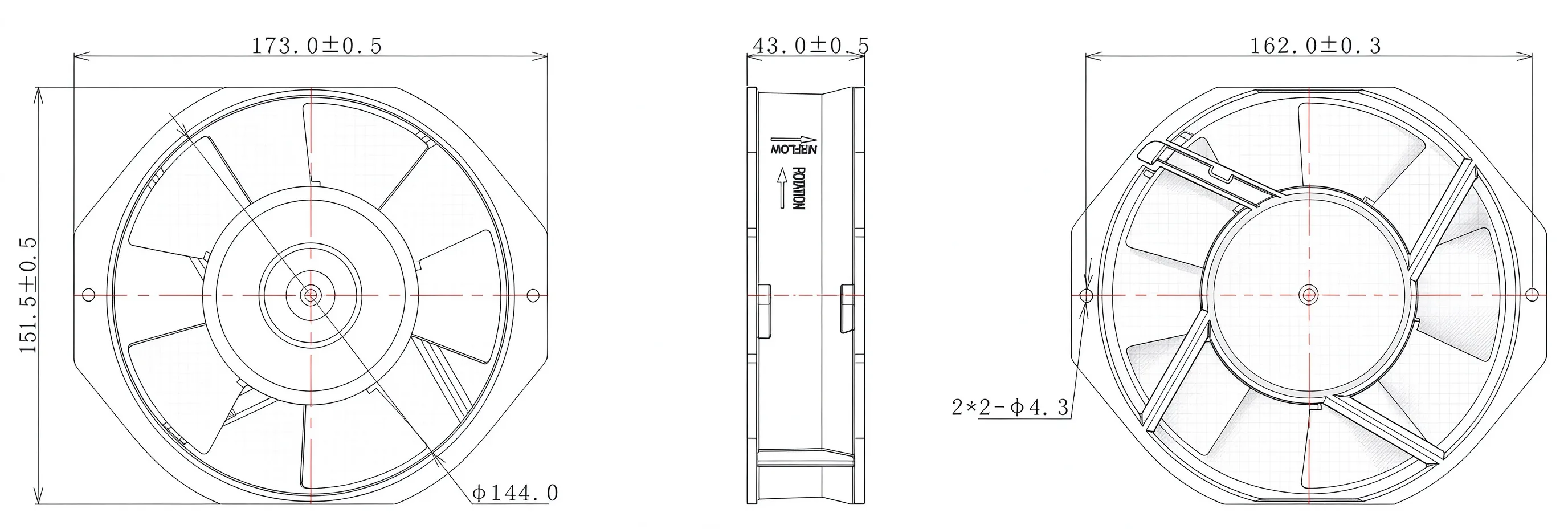
Full disclosure, because it saves everyone a week. ZHENDA makes panel and frame mounted AC axial fans — 31 rated models in the catalog, each published with rated data, most with dimensional drawings, from a Deqing, China factory founded in 1997, running a new 15,000 m² plant with 110 people, ten of them in R&D, and about 60% of output going to export customers. We do not list vane axial duct fans, and this page is not a disguised catalog for a product we don't build. What our line genuinely does: the 17238, for example, moves a rated 271 m³/h on 27 W at a reported 45 dB; the 25489 page posts a full pressure-flow curve — roughly 1,450 m³/h at free air, shutting out near 190 Pa, right about where OSU draws the line for panel-class fans and one clear reason it is panel-class. Standard models ship free samples, MOQ starts at 100 pcs, lead time runs one to two weeks, warranty is a year, and CE marks cover the twenty marked models. Now the part a competitor's blog won't tell you. If your project truly needs a vane axial — a ducted duty at several inches of water — buy it from a duct-fan specialist; the honest answer sometimes is not us. But if the resistance is lower than the spec sheet assumes, a square AC axial mounted as a wall or bulkhead unit often handles the job for a fraction of the cost, and we'll evaluate your airflow, pressure and drawings through the quote form and say which answer is which. Straight answers are cheaper than returns.
Sources
Read next:
Questions a brochure cannot answer?
Ask an engineer, not a chatbot — the quote form reaches our team.